Research
Subsurface heterogeneity
The dynamics of coastal rivers and deltas create heterogeneous deposits that influence subsurface fluid flow patterns. Geological heterogeneity strongly influences flow pathways and thus rates of contaminant transport and groundwater aquifer recharge, which limits our ability to sustainably manage water resources and mitigate health risks in river-delta environments. Spatial scales of subsurface stratigraphic variability in river-deltas ranges from micron-scale pore-space discontinuities to irregularly-shaped sand-bodies that can be tens of meters thick and many kilometers in length. Smaller-scale subsurface heterogeneity due to channel and bedform dynamics (<1~m) is typically under-constrained, because it is below the resolution that can be imaged by geophysical techniques.
In research under this theme, we have used numerical modeling, information theory, and machine learning models to understand heterogeneity in the subsurface.
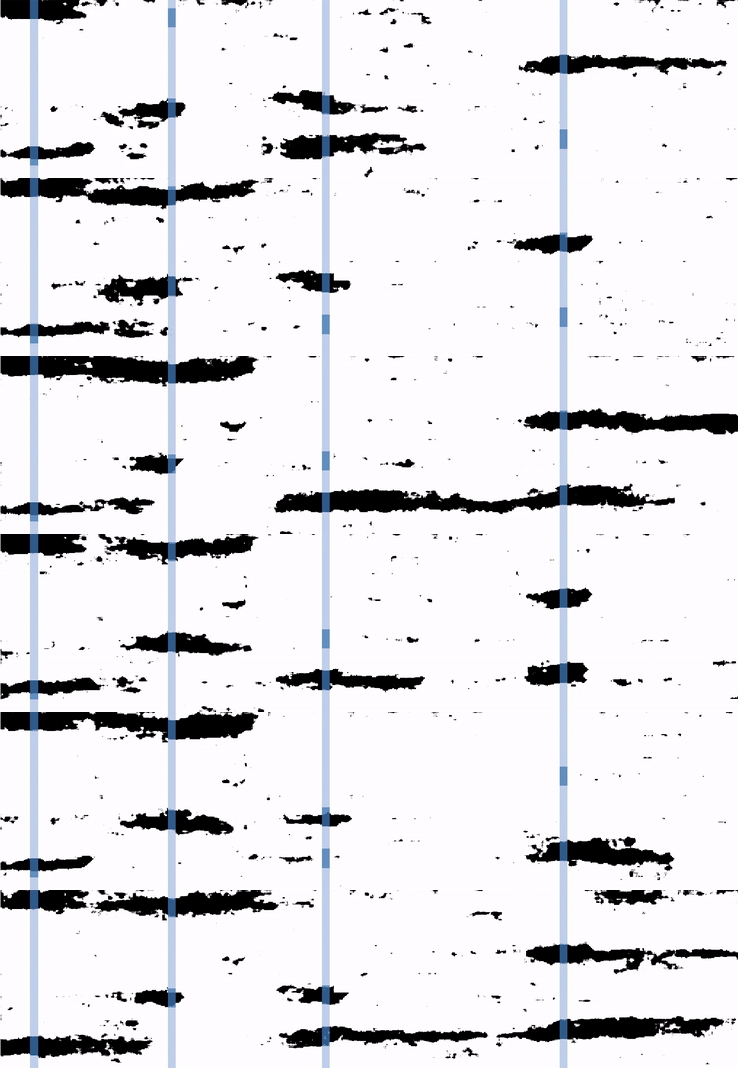
We produced a deep-convolutional generative adversarial network (StratGAN) that has learned to produce synthetic synthetic fluvial stratigraphy, where black pixels represent channel, and white is non-channel. A novel contribution of this research project was coupling texture-synthesis algorithms (missing reference) with conditional in-painting optimization (missing reference), to “scale up” realizations from the machine learning model while honoring ground-truth data (e.g., cores).
Publications generated by this research
There are no peer reviewed publications from this work.